

TL;DR
- U.S. law has no separate regime for peptides. A product’s status depends on how it is used, what you claim, and how large the molecule is.
- BPC-157 and the other peptides an FDA committee backed in July 2026 still cannot be lawfully compounded. Only a final FDA rule can change that, and none has been proposed.
- A “research use only” label does not protect a seller to consumers. FDA, prosecutors, and drug makers treat it as evidence.
- Compounded GLP-1 drugs can now be sold only for a documented patient need. A business built on mass-produced copies of Wegovy or Zepbound no longer has a legal basis.
- For investors, the legal basis of a peptide business comes before its revenue. A company that cannot show that basis for each product, supplier, and prescribing decision may not survive diligence.
In late July 2026, an advisory committee of the U.S. Food and Drug Administration (“FDA”) voted to recommend that pharmacies be allowed to compound six popular peptides. Compounding means that a licensed pharmacy makes a drug itself from raw ingredients, usually for a specific patient, without FDA approving the finished product. The best known of the six is BPC-157, a synthetic chain of 15 amino acids sold for injury recovery and gut health. It is not an approved drug and is not on the list of ingredients pharmacies may use.
Many peptide sellers presented the vote as legalization. Legally, nothing changed. The committee only advises FDA, and FDA’s own reviewers had recommended against every peptide on the agenda. The vote came after the U.S. Department of Health and Human Services added new members to the committee in June 2026, several of them with ties to peptide clinics. As of October 1, 2026, FDA has not proposed a rule.
This guide is for you if you are building a peptide business or deciding whether to fund one. It covers compounding pharmacies, telehealth brands, online “research use only” sellers, supplements, and cosmetics, and ends with what to check before you sign a term sheet.
Is a Peptide a Drug, a Biologic, a Supplement, or a Cosmetic?
Peptides are short chains of amino acids. Many hormones are peptides, and so are today’s best-selling peptide drugs, the glucagon-like peptide-1 (“GLP-1”) drugs. The best known are semaglutide, sold as Ozempic and Wegovy, and tirzepatide, sold as Mounjaro and Zepbound. Legally, a peptide product can be a drug, a biologic (a type of drug), a supplement, or a cosmetic. Three questions decide which: how the product is used, what you say it does, and how large the molecule is.
Start with how the product is used. An injectable peptide is always a drug or a biologic and can never be a supplement or a cosmetic. Then look at what you say about it. A promise to treat or prevent a disease makes any product a drug. A cosmetic also becomes a drug if it claims to change how the body works, while a supplement may claim to support normal function. FDA judges those claims by everything you publish: the label, the website, ads, and social posts (21 C.F.R. § 201.128). Finally, count the amino acids: a chain of more than 40 is a biologic (21 C.F.R. § 600.3(h)(6)). That is how the same molecule can be a lawful cosmetic in a face serum and an unapproved drug in a vial with a syringe.
Apply those questions to the market, and most peptides popular today turn out to be drugs. Injectable peptides sold for recovery, longevity, or fat loss, such as BPC-157, CJC-1295, and ipamorelin, are unapproved drugs. Semaglutide and tirzepatide are approved drugs, and pharmacy versions of them are compounded drugs. Collagen peptides in supplements and copper peptides in skincare are the main products outside the drug rules.
An unapproved drug may not be shipped or sold across state lines for use in people, which covers any online sale (21 U.S.C. § 355(a)). There are two main exceptions: clinical trials under FDA oversight, and compounding, where the pharmacy may use only ingredients the law permits. Most businesses in this guide depend on which ingredients qualify, and that is what the July vote was about. BPC-157, CJC-1295, and ipamorelin qualify for neither exception, and selling them anyway risks FDA warning letters, seizures, and, in serious cases, criminal charges. GLP-1 drugs are different: approved brands can be prescribed and shipped as usual, and compounded versions only within the compounding rules discussed below.
Which Rules Apply to Your Peptide Business?
The rows follow the supply chain, from the molecule to the patient. Find your row by what you actually do rather than by the label you use. Compliance complexity shows how much it takes to run each model lawfully: approvals, licenses, and ongoing rules.
Named companies illustrate each business type; the table does not assess any company’s compliance.
One company often sits in several rows. A typical telehealth brand is a platform and a marketer, and it prescribes through an affiliated medical group. Developers and manufacturers follow the standard FDA path of trials and approval. It is expensive but well understood, so the rest of this guide covers the other rows.
Can a Pharmacy Compound BPC-157 and Similar Peptides Today?
No. A traditional compounding pharmacy (“503A pharmacy,” after the section of the federal statute) may compound from a bulk ingredient only if the ingredient passes one of three tests. The ingredient must have a so-called monograph, an official quality standard, in the United States Pharmacopeia, the book of drug standards that federal law recognizes; be a component of an approved drug; or appear on FDA’s 503A bulks list. BPC-157 and the other five peptides the committee recommended pass none of them.
Some peptides common in clinics do pass. Sermorelin was part of an approved drug that left the market for business reasons, so a 503A pharmacy may compound it under the usual conditions. Where popular peptides stand as of October 1, 2026:
An April 2026 step also confused the market. On April 15, 2026, FDA took 12 peptides, BPC-157 among them, off its list of ingredients that raise significant safety risks in compounding. At the same time, it sent them to the committee for review. Neither step added them to the permitted list. Only a final rule can, and rulemaking has no deadline. The first 503A bulks rule took more than two years, from proposal in December 2016 to final rule in February 2019.
If FDA does adopt a final rule, some things change and some do not. A 503A pharmacy could compound the listed peptides for individual patients with a prescription, as long as it meets the other 503A conditions, including buying the ingredient from an FDA-registered manufacturer. The peptides would still not be FDA-approved drugs. Nobody could market them as approved or make treatment claims, patients would still need a prescription, and “research use only” sales to consumers would remain unlawful. Production in batches for clinics would need a separate listing for 503B facilities, and FDA has not said it will review these peptides for that list.
States add their own rules. They cannot allow what federal law forbids, but they decide what a doctor may prescribe to patients in their state. In May 2026, Alabama’s medical board told physicians that research-grade peptides are prohibited for patients, so a doctor there can lose a license even if FDA never acts. Louisiana went the other way: its medical board may not discipline doctors who use peptides made by compounders that meet federal standards, which will matter mostly after an FDA rule.
Does a “Research Use Only” Label Protect an Online Peptide Seller?
No. Selling research reagents to real laboratories is lawful. The problem starts when the buyers are consumers, because FDA then reads the label together with everything else the seller publishes.
On August 24, 2026, FDA sent warning letters to five online peptide sellers. FDA cited dosing guidance, a “peptide calculator” for preparing injections, and bacteriostatic water sold alongside the vials. It concluded that the products were drugs for human use “despite statements on your product labeling.”
We do not name the recipients of FDA warning letters in this guide. A warning letter states FDA’s position at the time it is sent. It is not a court finding, and the recipient may respond, correct the issues, or dispute them, after which FDA may close the matter. The letters are public on FDA’s website.
Prosecutors go further. If your site sells vials next to dosing charts and mixing water, the words “not for human use” will not protect you. To a prosecutor, they show that you knew how the products were used and tried to hide it, and that intent can turn a regulatory violation into a felony. In July 2026, the owner of Paradigm Peptides, which sold research-labeled peptides, received a 70-month federal prison sentence. Prosecutors said some products contained testosterone instead of what their labels listed. The same month, the owner of Milestone Purity received 21 months for selling Chinese-made semaglutide and tirzepatide labeled for “research purposes only.”
Drug makers sue too. On August 12, 2026, Eli Lilly sued six sellers of products claiming to contain retatrutide, its obesity drug still in Phase 3 trials, including some labeled for research.
These sellers also lose mainstream ads and payments. Google and Meta require certification from LegitScript, a private verification service, to advertise prescription drugs, and an unapproved-drug seller cannot get it. That leaves high-risk payment processors, with higher fees and frozen reserves.
Can a Telehealth Company Still Build a Business on Compounded GLP-1s?
Yes, in a narrow form. Patients still want these drugs, but FDA and the courts have closed the routes that made mass compounding possible. In this model, the telehealth company connects patients with prescribers, and a partner pharmacy compounds and ships the drug.
The shortages that allowed mass compounding are over. While an approved drug is on FDA’s shortage list, the law lets pharmacies make copies of it. FDA removed tirzepatide from that list in late 2024 and semaglutide in February 2025, and in August 2026 the U.S. Court of Appeals for the Fifth Circuit upheld both decisions.
Without a shortage, a 503A pharmacy may not regularly compound what is “essentially a copy” of an approved drug. Compounding exists for patients whom the approved drug does not fit. A different formula is allowed only if the prescriber documents that the change makes a significant difference for an identified patient. FDA does not act against a pharmacy that fills four or fewer prescriptions for a copy in a month, which is no basis for a national business.
Much of the market tried to get around this through “personalization.” Telehealth brands kept selling compounded semaglutide and tirzepatide with an added ingredient, usually vitamin B12, and a note from the prescriber that the change was medically needed.
FDA has rejected that approach. On April 1, 2026, it said that a product with the same active ingredient, at a similar strength and by the same route, remains a copy unless the prescriber decides and documents a significant difference for an identified patient. In a warning letter on September 18, 2026, FDA treated B12 and niacinamide versions as copies and called the differences “pretextual,” given the volume produced. It also criticized boilerplate medical notes and telehealth platforms that offer prescribers pre-selected reasons. If every patient gets the same formula and the medical reason comes from a dropdown, the product is a copy.
The question is now in court. In Eli Lilly & Co. v. Mochi Health Corp., No. 3:25-cv-03534 (N.D. Cal.), Lilly alleges that Mochi Health sold standardized, mass-compounded tirzepatide as “personalized” and let non-physicians control medical decisions. The court dismissed the first complaint in October 2025 for lack of standing, let amended claims proceed in April 2026, and narrowed them in September 2026. The case is still at an early stage, and no court has decided whether the allegations are true.
Outsourcing facilities (“503B facilities”) make compounded drugs in batches for hospitals and clinics, without a prescription for each patient. They already cannot use bulk semaglutide, tirzepatide, or liraglutide now that the shortages are over. On April 30, 2026, FDA proposed to make that exclusion permanent. The proposal is not yet final.
Marketing draws much of the enforcement. In March 2026, FDA announced 30 warning letters to telehealth companies, its second large wave after one in September 2025. The letters objected to phrases such as “Generic Zepbound” and “Contains the active pharmaceutical ingredient in Wegovy,” and to calling compounded drugs FDA-approved. In July 2026, the Federal Trade Commission, Utah, and Los Angeles County sued Hims & Hers, alleging hidden subscriptions and sharing of health data with advertisers.
The model that holds up legally prescribes brand-name drugs, often through manufacturer programs such as LillyDirect and NovoCare, and compounds only for a documented patient need.
How Is a Telehealth Peptide Company Usually Structured?
Let’s say you are launching a telehealth platform and an investor asks who makes the medical decisions. The answer had better not be you, unless you hold a medical license. Many states do not let a company owned by non-physicians practice medicine, so investors can own the platform but not the medical practice. Prescribing sits in a separate medical group owned by a licensed physician. The platform can be paid for marketing, software, and billing, but it cannot tell the doctors what to prescribe or to whom. The group is tied to the platform by a management agreement and by limits on transferring its shares, so the business does not depend on one doctor. A partner pharmacy fills the prescriptions.
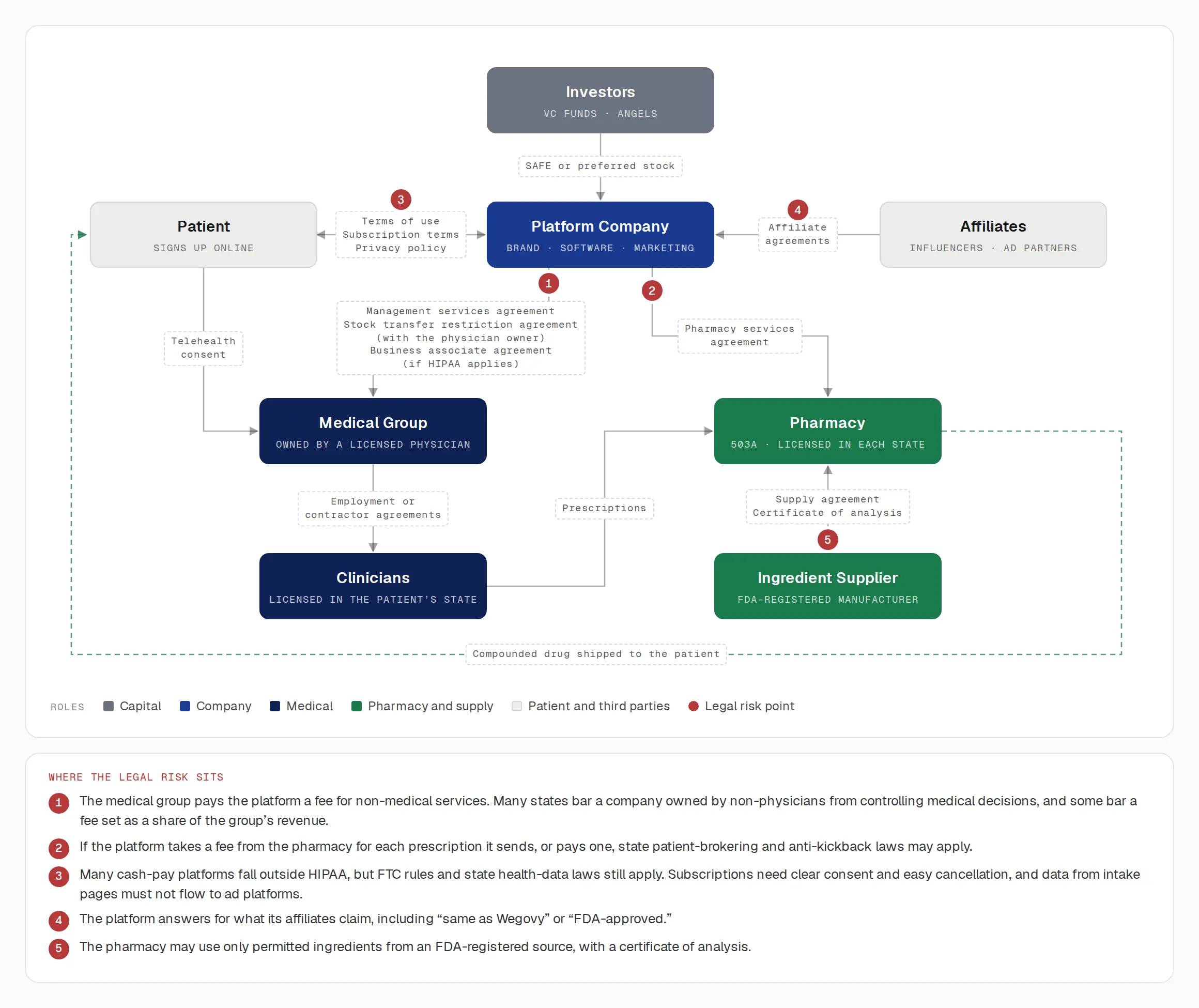
In the brand-name model, the pharmacy dispenses an approved drug, often through LillyDirect or NovoCare, and no ingredient supplier is needed. The rest of the structure stays the same.
The line between the platform and the doctors is now being tested in court in the Mochi Health case. Before you raise, check three things:
- Who owns the medical group?
- How does the platform pay, and how does it get paid?
- Who actually approves the treatment protocols?
If the answer to any of them is the company rather than its physicians, the round may not survive diligence.
Can a Peptide Be Sold as a Supplement or a Cosmetic?
Sometimes. Collagen peptides are broken-down animal collagen, close to gelatin, and have long been sold as food, so they are legal as supplements. Synthetic peptides such as BPC-157 would be new dietary ingredients. Each would need a notification to FDA 75 days before sale. We are not aware of one for BPC-157 that FDA has acknowledged without objection.
Topical peptides in skincare are lawful cosmetics as long as the claims stay about appearance. “Improves the look of fine lines” is a cosmetic claim. A claim that the product rebuilds collagen or repairs skin makes it a drug.
What Should an Investor Check Before Funding a Peptide Company?
Check the legal basis for each product and each sales channel before you look at revenue.
A telehealth startup plans to ship BPC-157 nationwide and assumes FDA will add it to the 503A list in 2027. Even then, as the pharmacy section explains, the rule would allow only patient-specific prescriptions filled by licensed pharmacies, and sales to clinics would still need a separate 503B listing. The valuation rests on a rule that would cover only part of the business.
Red flags you can spot in a minute:
- the website calls a compounded drug “generic,” “the same as” a brand, or “FDA-approved”;
- “research use only” products appear next to dosing charts or reconstitution calculators;
- the catalog includes retatrutide or other drugs still in clinical trials;
- the supplier is an unnamed overseas source, or its certificates of analysis cannot be traced to a real lab;
- the company kept selling a product after an FDA warning letter about it;
- the platform, not its physicians, controls prescribing decisions; or
- subscriptions renew without clear consent, or tracking pixels send health data to ad platforms.
In the deal documents, ask for specific representations on FDA compliance and a special indemnity for pre-closing regulatory issues. Tie later tranches to regulatory milestones, such as a final FDA rule.
What Does a Fundable Peptide Company Look Like?
It can show you, on paper:
- the regulatory basis for each product, by name;
- the pharmacy or manufacturer behind each product, with its license or FDA registration; and
- marketing reviewed against the claims FDA has already challenged in warning letters.
Nothing in this article constitutes legal advice. Buzko Legal advises founders and investors in digital health and life sciences on venture financings, cross-border structuring, and legal due diligence. If you have any further questions or just want to give us a high five, feel free to contact us on LinkedIn, X, or via email info@buzko.legal.
Contacts

.svg)


.svg)
.svg)