

The ancestors of modern data centers appeared in the 1940s together with the first electronic computers. One of the best known was ENIAC (Electronic Numerical Integrator and Computer), unveiled to the public in 1946 at the University of Pennsylvania. ENIAC weighed dozens of tons and filled an entire room. One of its main tasks was calculating artillery firing tables, work that until then had been done by people by hand using mechanical calculators.
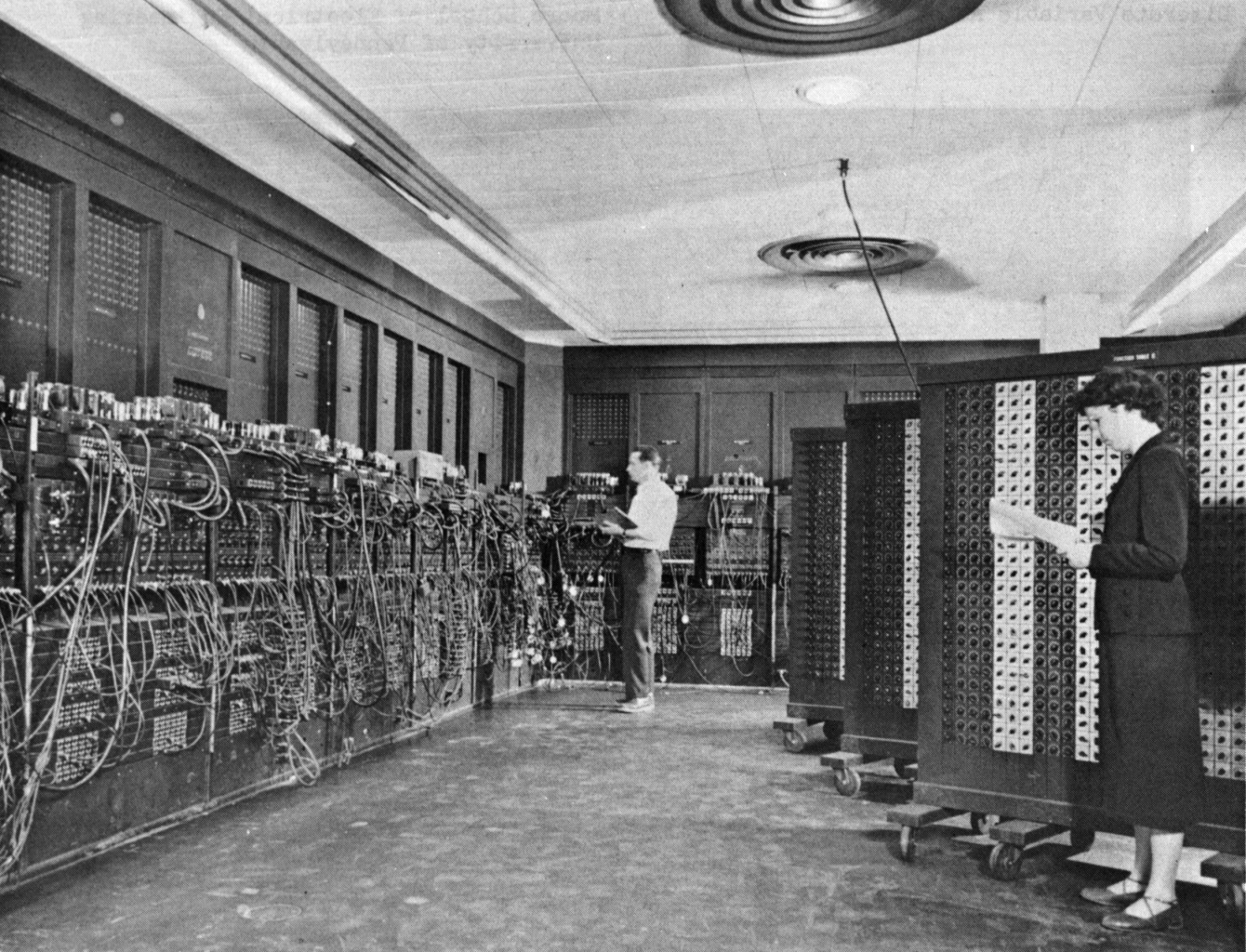
ENIAC, one of the early general-purpose electronic computers
Over time, computers became smaller and cheaper. With the arrival of microprocessors, computing power could be packed into far more compact devices.
In the 1990s, the internet began to grow rapidly, and with it the number of servers, the computers that run websites, databases, and other online services. Servers were installed by the dozen in special racks, and racks were installed by the hundreds and thousands in purpose-built buildings with uninterrupted power supply, internet connectivity, and cooling systems. These facilities came to be known as data centers.
Companies that needed significant computing power often had to buy physical servers in advance, house them, connect them to the internet and to power, cool them, and maintain them. The hardware usually had to be bought with a margin for peak load, so part of the capacity could sit idle outside peak periods.
An obvious question arose: what if you did not buy servers at all and instead rented computing power only when you needed it?
The Rise of Cloud Computing
In August 2006, Amazon launched a beta version of EC2 (Elastic Compute Cloud), a service that allowed anyone to rent a virtual server over the internet for 10 cents an hour. Instead of buying your own hardware, you could use someone else’s for as long as you needed it.
The key advantage was that very “elasticity”: the ability to quickly scale rented computing resources up and down with demand, paying only for the time used.
This was an important milestone in the development of modern cloud services. Twenty years later, the global cloud infrastructure market is led by AWS (Amazon Web Services), Microsoft Azure, and Google Cloud, whose operators are commonly called “hyperscalers.” According to Synergy Research Group, in the second quarter of 2026 these three providers held market shares of 28%, 20%, and 15% respectively, together more than 60% of the entire market.
As the cloud market grew, hyperscalers expanded their infrastructure. They built their own data centers and leased space and capacity from specialized operators.
In traditional cloud servers, most of the computing work was done by central processing units, or CPUs. These are general-purpose devices for all kinds of computing tasks, from running websites to processing database queries.
In parallel, in the 2010s, a different line of business was developing: “mining farms,” complexes of computing equipment used to mine cryptocurrencies. Instead of serving websites, this equipment repeatedly performed cryptographic calculations, competing for the right to add a new block to the blockchain and receive a reward in cryptocurrency. Graphics processing units, or GPUs, proved well suited to mining some cryptocurrencies. They were originally designed for rendering computer graphics, but their ability to perform many similar calculations in parallel turned out to be useful for other tasks as well. For example, GPUs were widely used to mine ether, the cryptocurrency of the Ethereum network, until mining on that network ended in September 2022. CoreWeave, which later became one of the largest “neoclouds,” started out mining Ethereum.
November 2022
In late autumn 2022 came what is sometimes called the “ChatGPT moment.” On November 30, OpenAI introduced its chatbot ChatGPT to the world. Today there are many such bots, and hundreds of millions of people use them every day.
Behind services like these are trained large language models or LLMs. GPUs are highly effective for training them because they can perform many similar operations in parallel (above all, matrix multiplication). GPUs are used not only for training but also for “inference,” meaning the application of a trained model to new data. For chatbots, this means processing user requests and generating responses.
Against this backdrop, demand for specialized cloud infrastructure for AI computing grew rapidly. One might have expected the hyperscalers to take the entire new segment without difficulty. But demand for such computing and for GPUs grew faster than the hyperscalers could bring new capacity online.
This opened a window of opportunity, including for companies with a background in crypto mining. Their sites and existing power connections allowed AI infrastructure to be deployed faster. That said, the sites needed to be refitted, and the specialized chips used for bitcoin mining were not suited to these tasks.
On this wave, a new segment of the cloud market emerged: “neoclouds,” specialized providers of GPU-based computing capacity for training and running AI.
Neoclouds Today
By 2026, neoclouds had become a notable segment of the AI infrastructure market. The structure of demand for their capacity has changed as well.
In the first years after the “ChatGPT moment,” the main source of demand was model training. Large projects by OpenAI, Anthropic, and other developers could occupy tens of thousands of chips for months. Now inference plays an increasingly important role. One reason is the spread of so-called agentic workflows, where a model does not simply answer a single question but performs a multistep task. It plans its actions, calls external services, checks the result, and continues working. A single user task may require a whole sequence of calls to the model, which increases the inference load even without growth in the number of users.
The scale of the change is also visible in forecasts. McKinsey estimates that global demand for data center capacity may grow from 82 GW in 2025 to 219 GW in 2030, or roughly 22% a year. In this scenario, inference becomes the largest category of workload by 2030 at about 93 GW, or 43% of total demand. That is roughly 1.5 times more than model training (62 GW). Gigawatts here reflect the electrical power the infrastructure requires, not computing speed.
The neoclouds themselves say the same. According to CoreWeave management, in the first quarter of 2026 more than half of the company’s computing capacity was used for inference.
The strategies of the neoclouds have diverged as well. Broadly, four types of company can be distinguished, depending on their main competitive advantage and customer base.
- Providers operating at hyperscaler scale and, in effect, serving the hyperscalers’ overflow demand. CoreWeave is the typical example. Their main advantage is access to capital and the scale of their GPU purchases.
- Companies that build their business around energy and infrastructure. Crusoe is an example. The bottleneck for data centers is increasingly electricity rather than equipment, so these companies first secure access to a power source and then place computing capacity around it.
- Developer-focused providers such as Lambda and Together AI. Among other things, they compete on convenience: ready-made tools for deploying and serving models, integration with popular software frameworks, and easy access for small teams.
- Regional and “sovereign” providers such as Nebius and G42 from the UAE. Their advantage is presence in a specific jurisdiction: compliance with data residency requirements imposed by law or contract, knowledge of local regulation, and relationships with governments, which increasingly want AI infrastructure of their own.
The lines between these types are blurred, because a single large deal with a hyperscaler, a model developer, or a government can noticeably shift the position of any of these companies.
How Investors See It
Within a few years, the neocloud segment has produced public companies worth tens of billions of dollars. CoreWeave and Nebius, both publicly traded, have become the market’s benchmark for what this business is worth, and at the same time a clear illustration of its risks.
CoreWeave’s revenue in the second quarter of 2026 was $2.6 billion, and its contracted backlog stood at $104 billion. This is not cash in the bank. To receive it, CoreWeave must still deliver the promised capacity to its customers. The company’s debt at the end of the quarter was about $35.1 billion, and its capital expenditure for the whole of 2026 was estimated at $35 billion to $39 billion. The picture at Nebius is similar. Quarterly revenue grew 454% year on year to $582 million, but at the end of the quarter the company held $8.04 billion in cash against $8.55 billion in debt, and its capital expenditure for 2026 is planned at $20 billion to $25 billion.
In other words, both companies are building capacity in anticipation of future demand, partly financed with debt, and earning the revenue later. Customers close part of the gap themselves. According to Nebius, roughly 70% of the deals signed in the second quarter of 2026 include prepayments covering 50% to 60% of the related capital expenditure. For the provider, this reduces the need for borrowed capital, but it also creates a firm obligation to deliver the capacity on time.
The equity market is optimistic. By the end of August 2026, CoreWeave’s shares were worth twice their price at the company’s 2025 IPO, and Nebius’s shares had risen almost tenfold since the start of 2025. Debt financing, however, costs neoclouds more. According to Cbonds, CoreWeave’s bonds maturing in 2030 traded at a yield of around 9.6% to 9.75% a year, while the benchmark for investment-grade hyperscaler bonds was 4.8% to 5.8%.
What Comes Next
This is a market where contracts worth hundreds of billions of dollars have appeared within a few years, but where no standard documentation and no settled regulatory or court practice has yet developed. Compute capacity agreements are written almost from scratch every time. Questions such as who bears the risk of idle equipment, delayed chip deliveries, or power outages are resolved differently in every deal. At the same time, computing power itself is beginning to turn into an exchange-traded commodity. Price indices for GPU rental are about to appear, and derivative financial instruments will follow.
We will cover this side of the business in future publications. We will look at the structure of a typical compute capacity agreement, the legal status of computing power as a commodity, and the regulation of derivatives.
Contacts

.svg)


.svg)
.svg)